Kindergarten Math

This page is dedicated to resources that support the 2026 Kindergarten curriculum as it relates to Mathematics learning.
While the program remains rooted in a play-based and child-centered approach, the 2026 update introduces clearer expectations and more intentional instruction in core areas to better prepare students for Grade 1. Click here to visit the Kindergarten-Grade 3 Mathematics Continuum.
The vision of the 2026 curriculum is to ensure all children develop the foundational knowledge and skills needed to communicate effectively, to solve problems, and to thrive in a global community.
Use the buttons below to navigate to each section of the Kindergarten page.
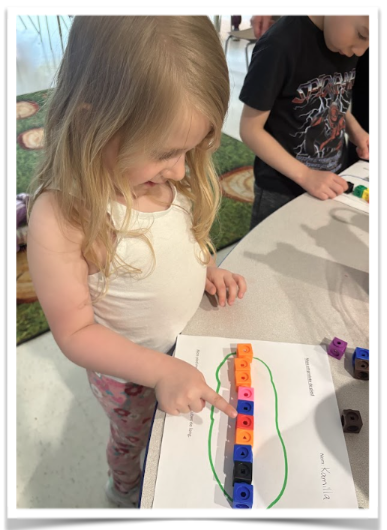
Whole Group
In this section, you will find resources to support whole group instruction for Mathematics as it relates to the 2026 Kindergarten curriculum.
Whole group Mathematics instruction includes intentionally planning and teaching concepts, knowledge, and skills with frequent teacher modeling and verbalizing of thought processes. Educators provide opportunities for students to practice using learned strategies, and to apply their knowledge and skills using concrete materials and/or pictures to make their thinking visible.
As students engage with their learning, educators guide and monitor progress, provide timely descriptive feedback to guide student learning until they can apply their own knowledge and skills independently, and frequently review previously taught concepts as students work towards accuracy, automaticity, and fluency.
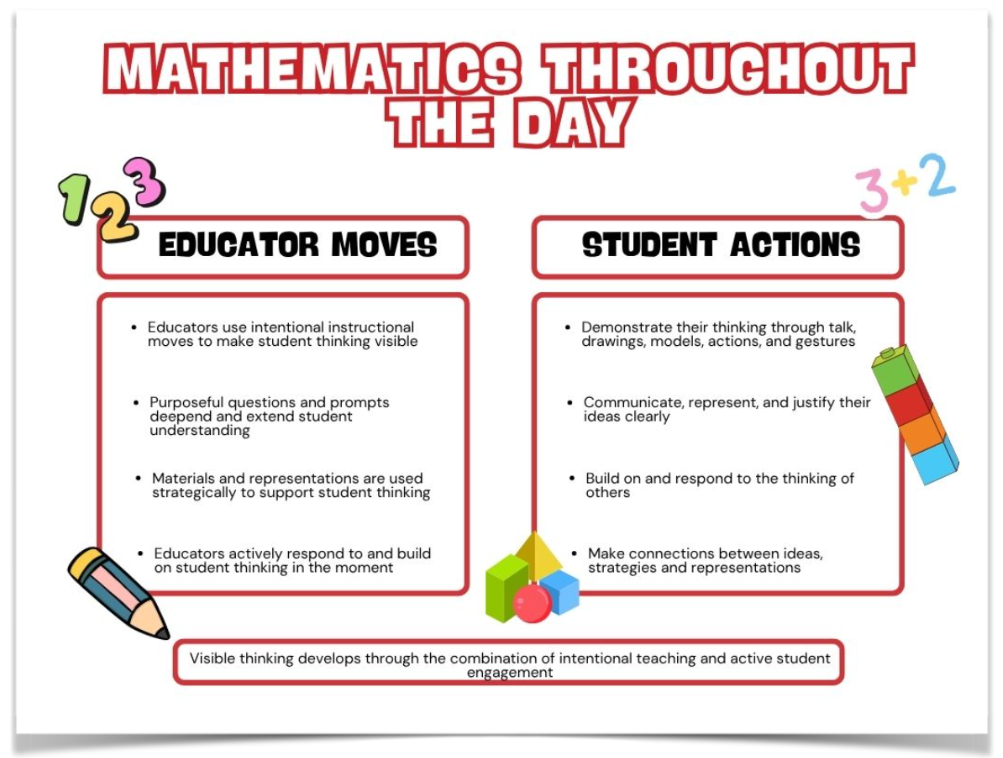

Visible thinking develops through a combination of intentional teaching and active student engagement. This document provides some insight on educator moves and student actions as we engage in whole group math talk with our students.
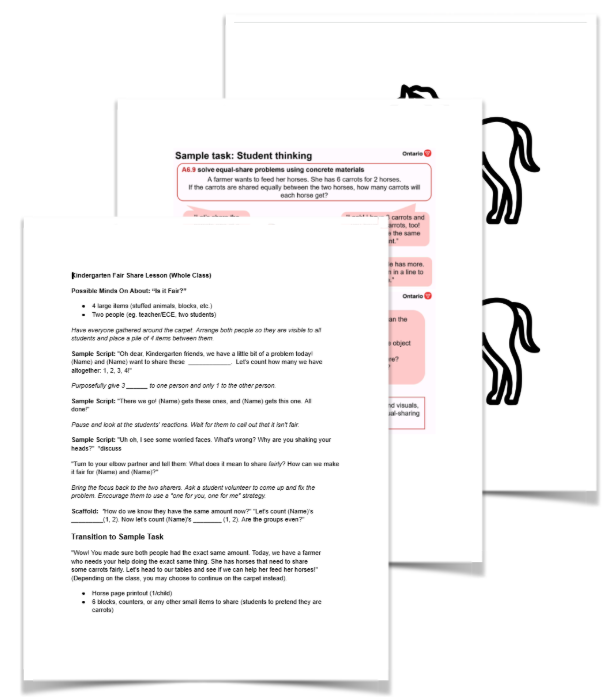
Click on the image below for a sample fair share lesson to accompany this video.
Number Talks
Number Talks should last around 10 minutes and are designed to build fluency with small numbers, develop 1-to-1 correspondence and conservation of number, as well as offer opportunities for counting. Click on the image to the right to see a suggested long-range plan of Number Talks for Kindergarten.
Use concrete materials to build conceptual understanding and to support the learning of strategies. Slowly transition to students using the strategies without the manipulative (concrete—>pictorial). As strategies change or become increasingly difficult, re-introduce the concrete materials to support student learning.
It is also helpful to build in routines that allow for wait time. After sharing the visual with students, provide wait time. Have students use a subtle hand signal (like a thumb-up against their chest) to show they have an answer and a strategy. This reduces the pressure on students who might still be thinking.
Benefits of Number Talks:
Builds Mathematical Language: Kids learn to use words like more, less, add, take away, and equal.
Encourages Risk-Taking: Because all answers are accepted initially and mistakes are treated as learning opportunities, students build math confidence.
Promotes Peer Learning: Children realize there is more than one way to solve a problem by listening to their classmates' unique strategies.
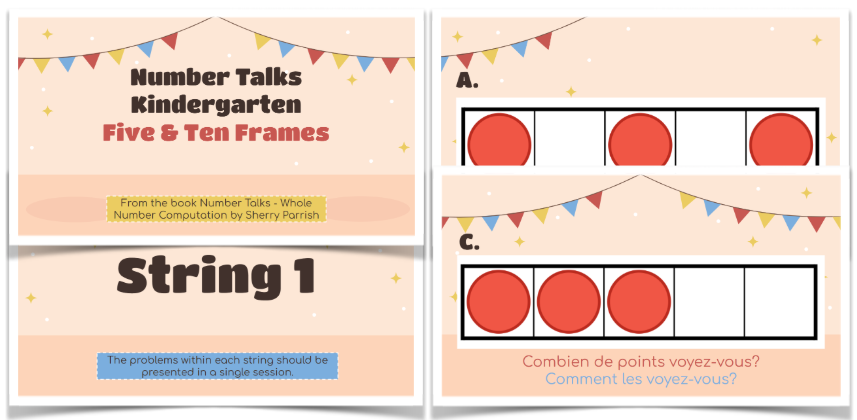

These five and ten-frame slide decks help build fluency, place value, and skills around subitizing, addition, and subtraction.
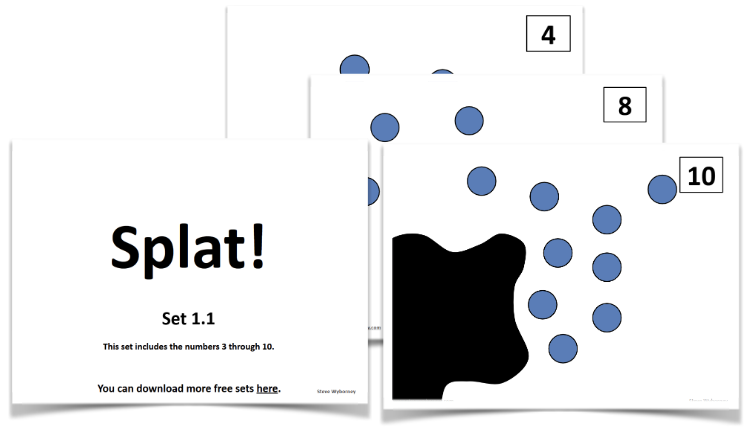

The following three slide decks are adapted from the Sherry Parrish book, Number Talks- Whole Number Computation, and include instructions, a sample video, dot images, and teacher prompts in both French and English.
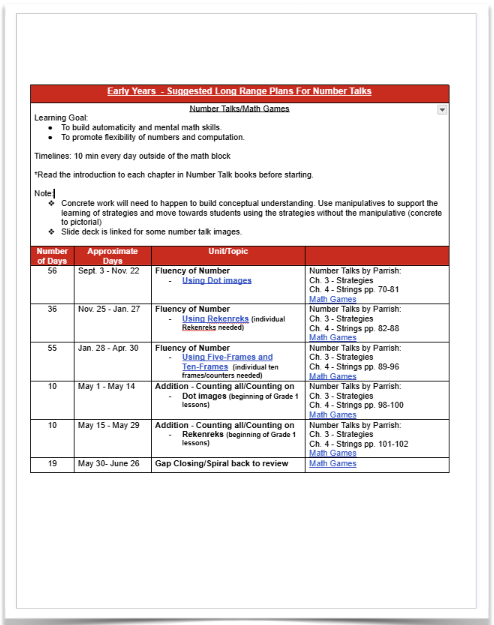
These “Splat” slides (numbers through 10 and 20) from Steve Wyborney’s Blog can support conversations about number.
Visit Steve Wyborney’s Blog for additional supports.
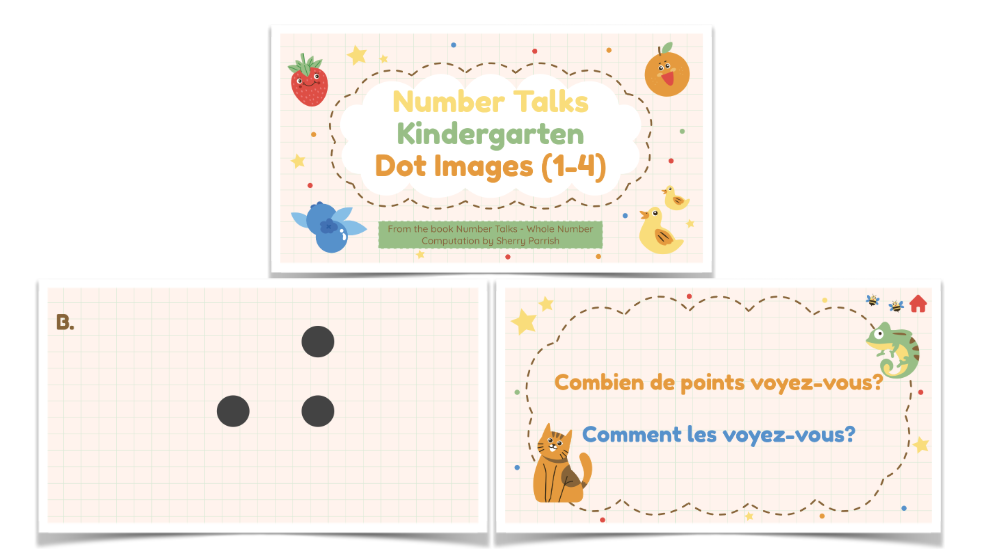
These dot image slide decks provide opportunities for students to work on counting, seeing numbers in different ways, subitizing, and learning number combinations.
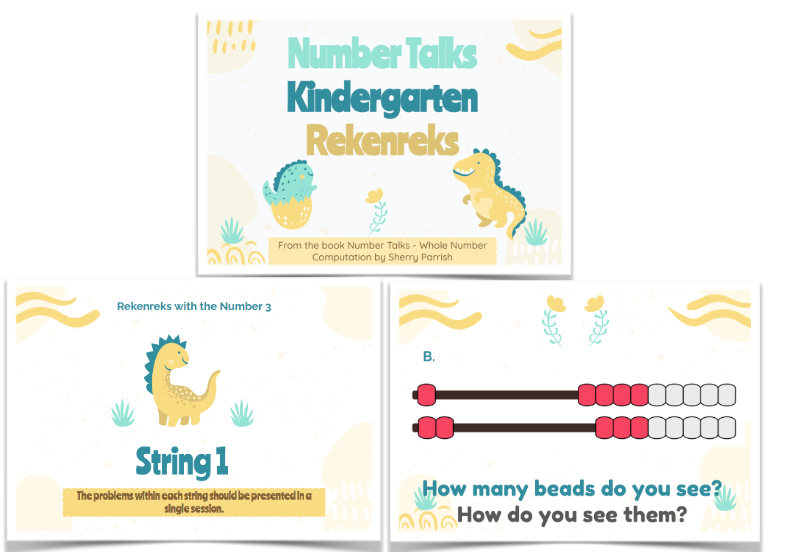
These Rekenrek slide decks are designed to help students reason about numbers, subitize, build fluency, and compute number relationships.
Math Games
In this section you will find math games that support learning in a variety of areas in the Kindergarten Flow of the Day.
Math games can be used to support learning of subitizing, composing and decomposing numbers, counting, addition and subtraction, coding, and more!
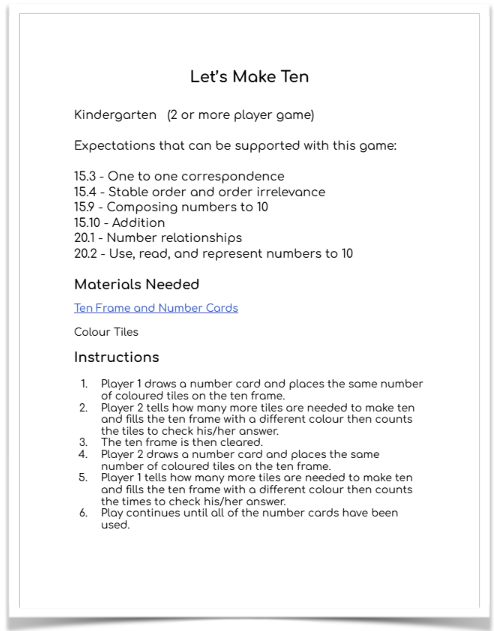
Let’s Make Ten (Addition)
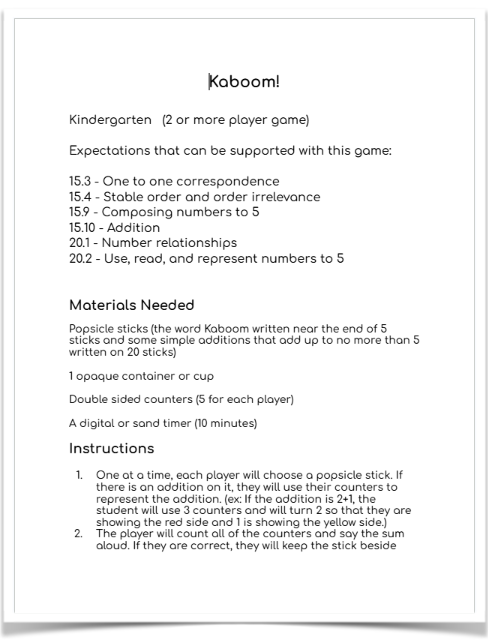
Kaboom! (Addition)
Part-Whole Bingo (Counting On, Subitizing…)
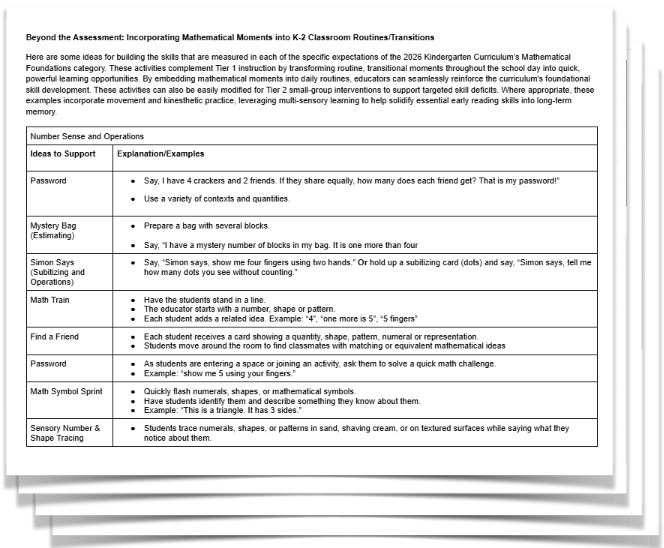
Incorporating Mathematical Moments Into K-2 Classroom Routines/Transitions
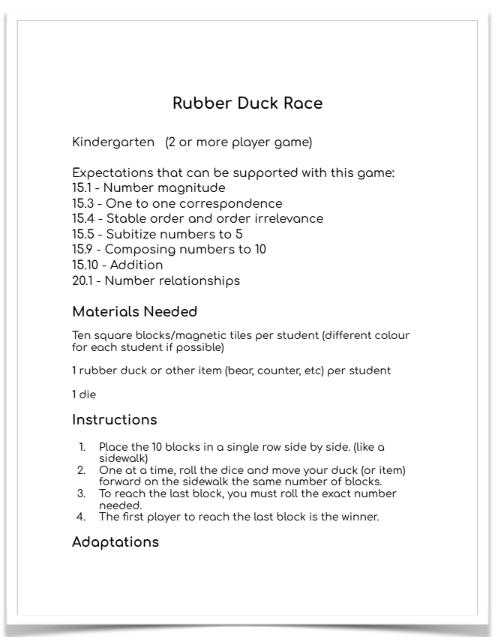
Rubber Duck Race (Addition)
Passenger Pairs (Five and Ten Anchors)
Bear Tracks (Cardinality)
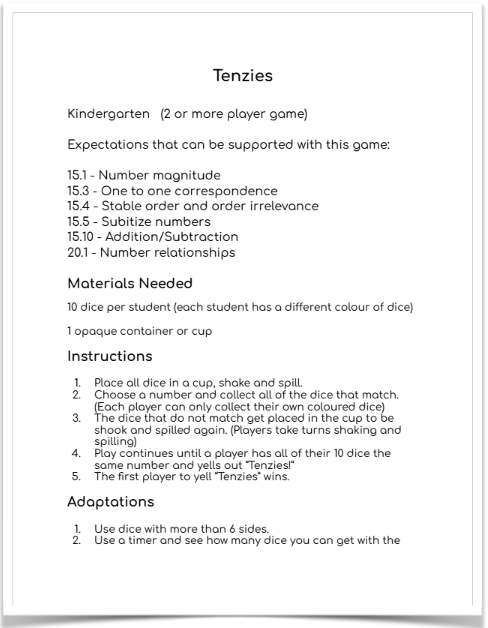
Tenzies (Subitizing)
Rekenrek Bingo (Counting On, Five Anchors…)
The Shoe Game (1-1 Correspondence, Counting…)
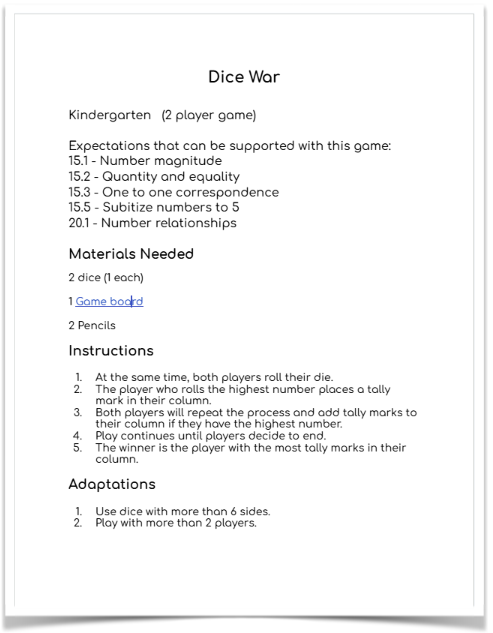
Dice War (Magnitude of Numbers)
Hide-and-Peek (Counting, Addition/Subtraction…)
Click here to explore some quick daily routines and small-group activities designed to build skills in the 2026 Kindergarten Curriculum’s Mathematical Foundations category. These multi-sensory activities are easily adaptable for Tier 1 and Tier 2 instruction and turn everyday transitions into powerful math moments.
Math Up

Math Up is a program available to all Kindergarten classes. It includes access to strand-based math topics, three part lessons, Kindergarten inquiries, additional activities, and professional learning supports.
Marian Small speaks directly throughout the program in short videos and notes and are meant to help build knowledge of Mathematics concepts and ideas and to develop effective instructional practices. It focusses on ideas, not just the skills, and includes multiple entry points to make learning accessible for all learners.
For more information, please contact the Learning & Teaching Team.

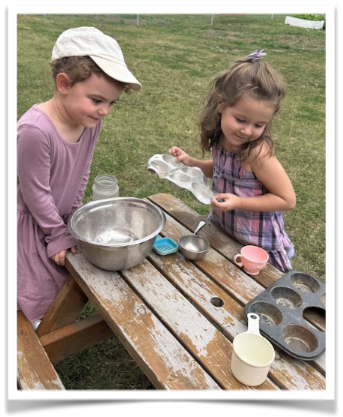
Play
In this section, you will find resources to support play in both indoor and outdoor settings, including sample visual models for integrating educator roles in the Flow of the Day as well as types of play along a continuum.
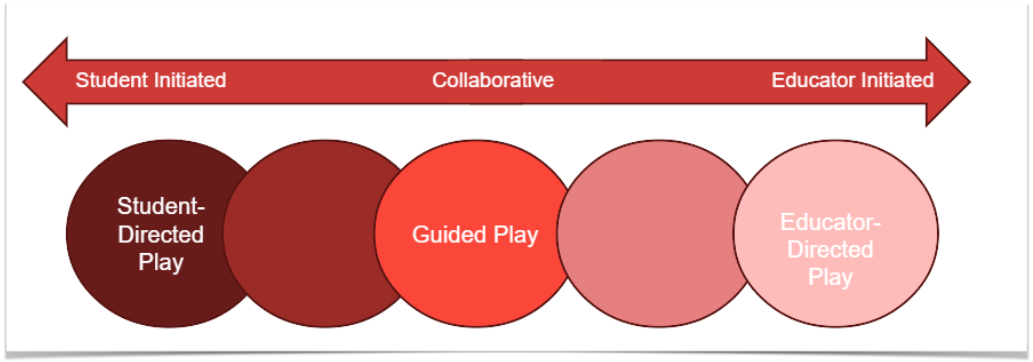
The Kindergarten curriculum identifies three types of play that exist along a continuum. From student-directed play to educator directed play, the level of child agency and educator involvement varies depending on the learning goals. Each type of play is important and understanding when to step back, when to arrange the environment, and when to step in directly, will help educators successfully meet curriculum expectations while preserving the play-based intentions of the Kindergarten curriculum.
The Continuum of Play-Based Learning
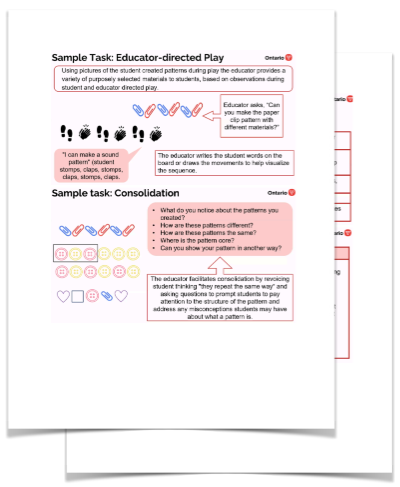
These sample math tasks for educator-directed play are aligned with the 2026 Kindergarten Curriculum and were originally shared during a Ministry webinar.
Each task includes helpful visuals, examples of student thinking, suggested educator prompts, and consolidation with insights into intentional planning for educator-directed play. Click on these images to explore the corresponding tasks.
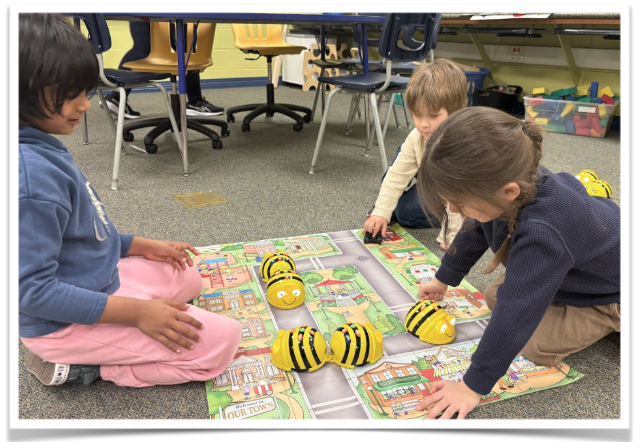
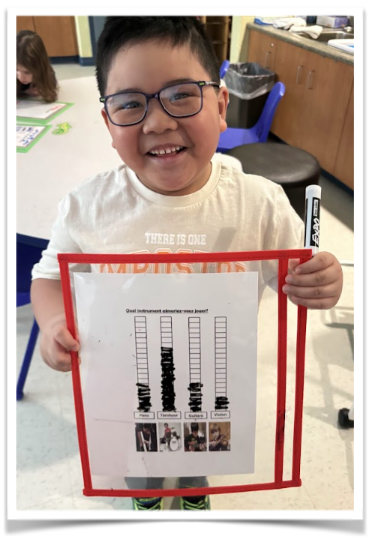
Task #1- A7.1: Patterns & Relationships
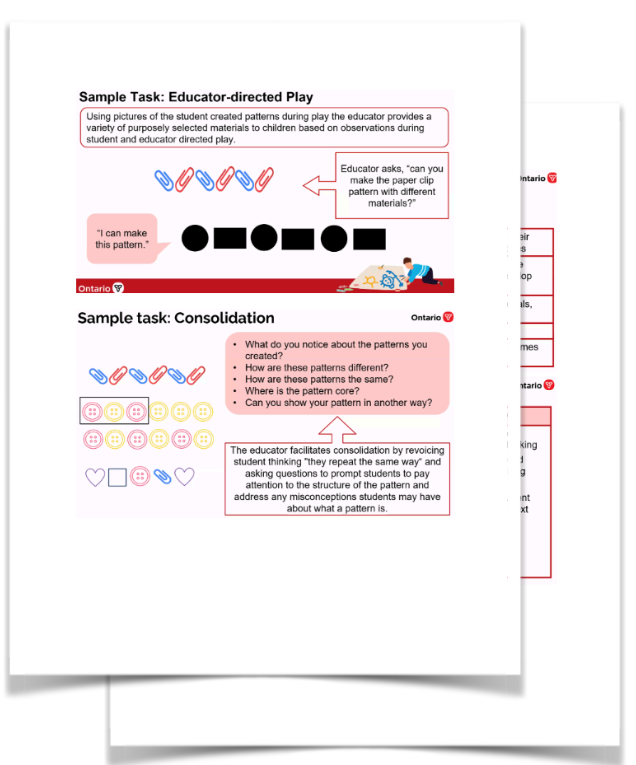
Task #2- A7.1: Patterns & Relationships
Additional Supporting Resources & Planning
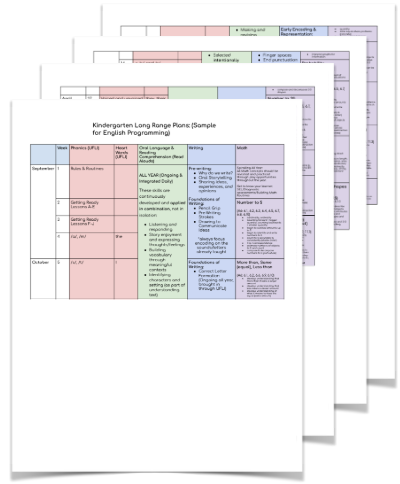
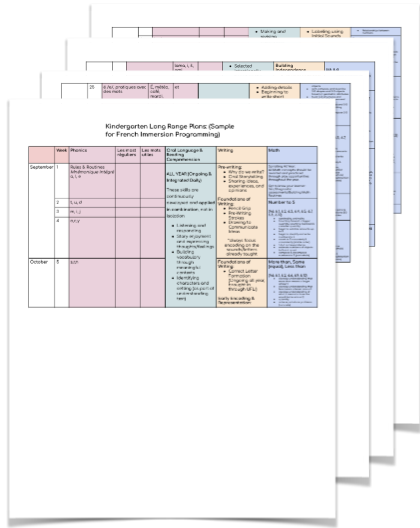
In this section you will find a comprehensive sample of a year-long curriculum plan for the 2026 Kindergarten curriculum (English and French Immersion), organized by month and week.
The framework details learning across main learning areas, including phonics, heart words, oral language & reading comprehension, writing, and math. Throughout the year, concepts overlap and are flexibly revisited based on student assessment data and specific needs.
Kindergarten- English
Kindergarten- French Immersion
Sample Math tasks
The following sample math tasks are related to expectations from the 2026 Kindergarten Curriculum.
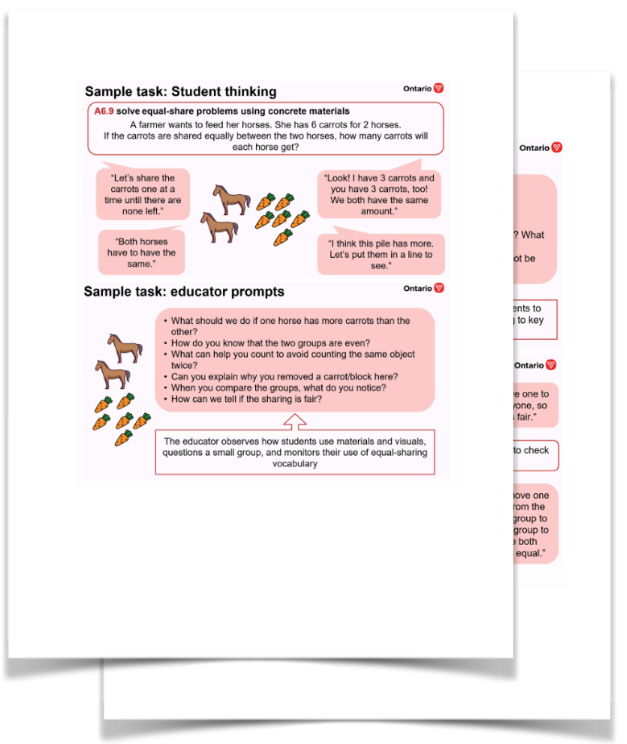
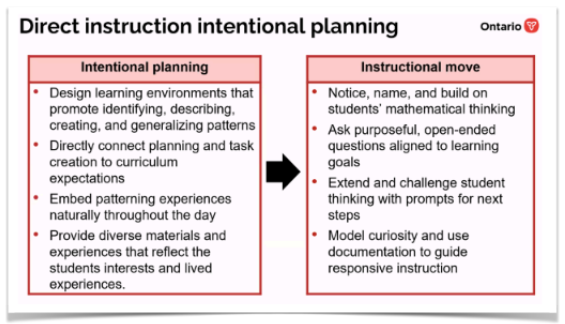
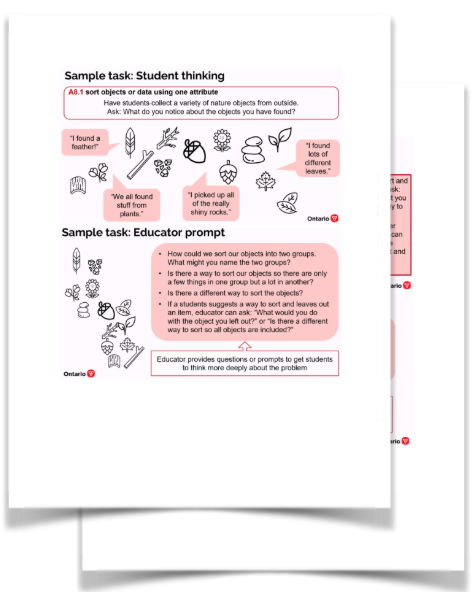
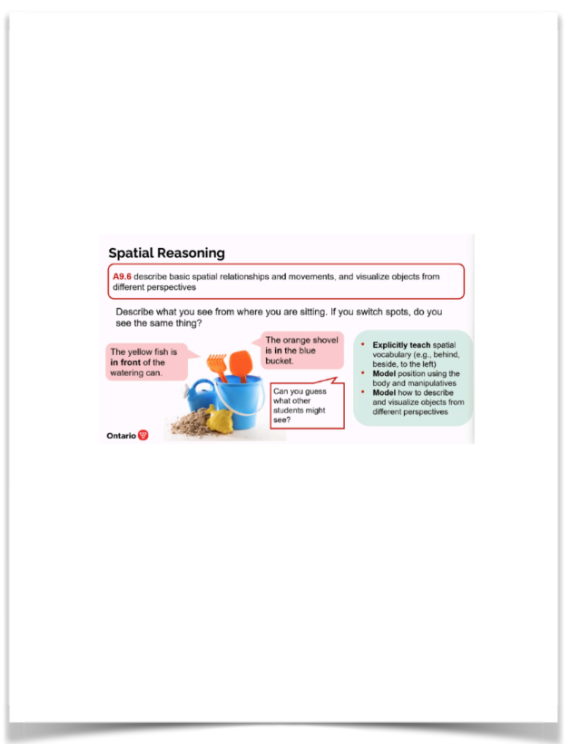
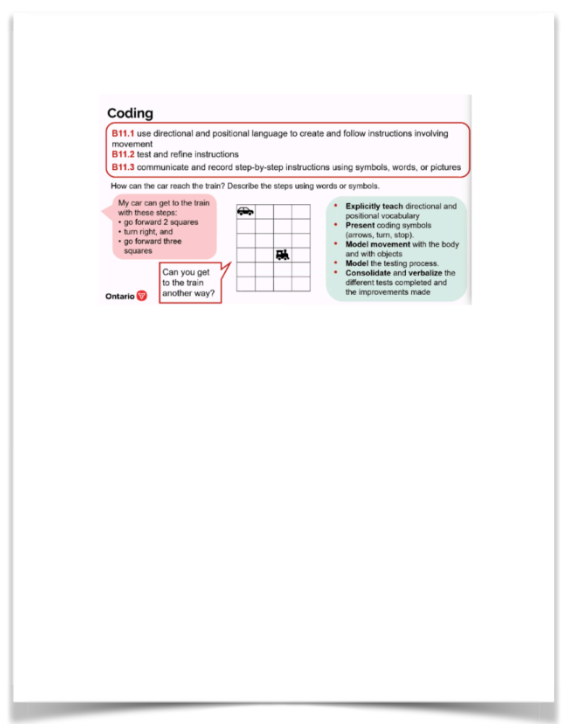
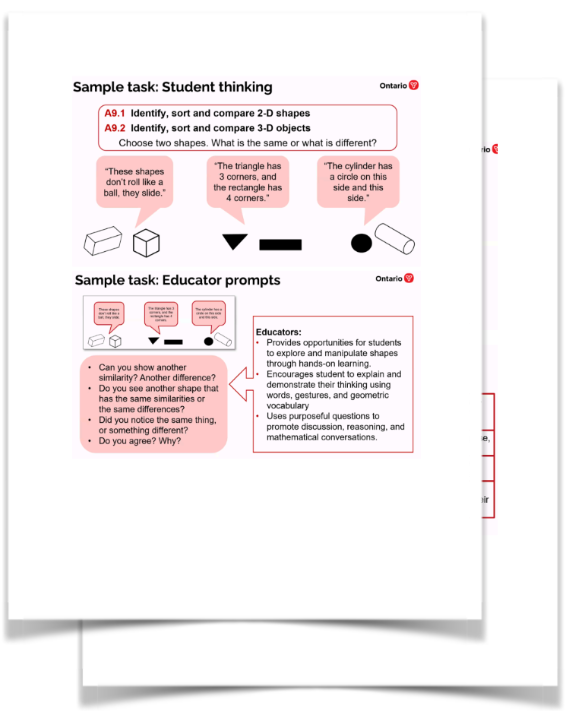
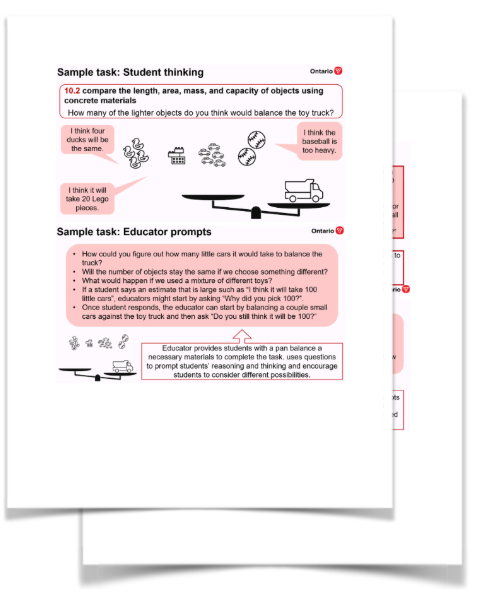
These slides were shared during a Ministry webinar and provide helpful visuals with samples of student thinking, educator prompts, consolidation, and insight on the intentional planning for direct instruction and educator-directed play. Click on each image to see the task.
A6.9: Number & Operations
Data & Probability / Sorting (A8.1)
Task #1- A7.1: Patterns & Relationships
Task #2- A7.1: Patterns & Relationships
Spatial Reasoning (A9.6)
Measurement (A10.2)
Geometry & Spatial Reasoning (A9.1/A9.2)
Coding (B11.1/B11.2/B11.3)
TVO Learn
TVO Learn’s Ontario certified educators have developed an overview of the Kindergarten program as well as a curated list of engaging videos, games, and activities to support learning.
Curriculum changes are coming for September 2026! Check back for new resources in the fall.
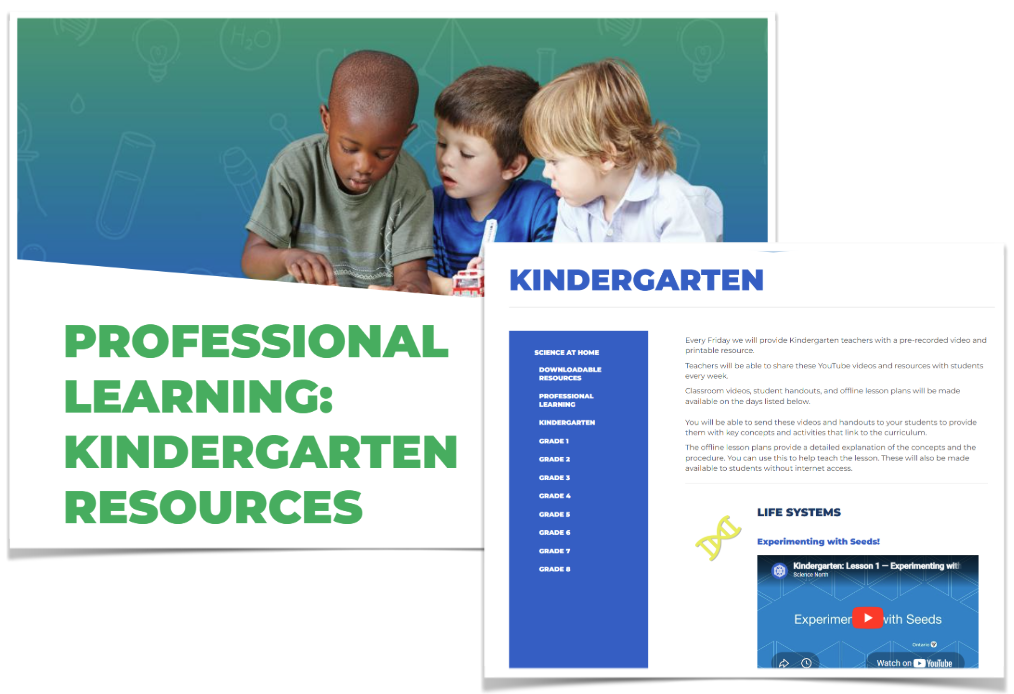
Science North- Professional Learning: Kindergarten Resources
Science North has developed new video resources, lesson plans, and supporting materials to help Ontario educators implement the Kindergarten curriculum.
These inquiry-based lesson plans highlight foundational concepts and skills within science, technology, engineering, and mathematics (STEM), including lessons related to coding.
Back to: